12 Unicycle
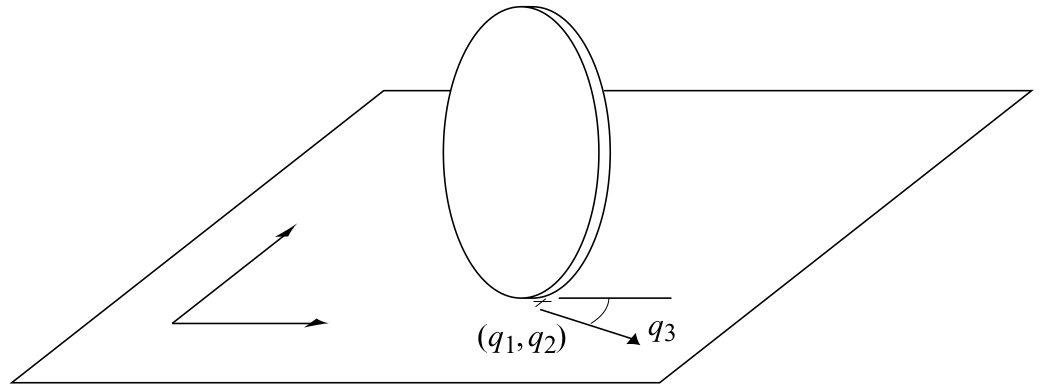
12.1 Dynamics
- Parameters
- state space \(\mathcal{X}\)
- action space \(\mathcal{U}\)
- State: \(\mathbf{x}= \begin{pmatrix}x, y, \theta, v, \omega\end{pmatrix}^\top \in \mathcal{X}\subset SE(2) \times R^2\)
- Position \((x,y)^\top\) [m, global frame]
- Orientation \(\theta\) [rad, global frame]
- Velocity \(v\) [m/s, global frame]
- Angular velocity \(\omega\) [rad/s, body frame]
- Action: \(\mathbf{u}= \begin{pmatrix} a_v, a_\omega \end{pmatrix}^\top \in \mathcal{U}\)
- Acceleration \(a_v\) [m/s^2, global frame]
- Angular acceleration \(a_\omega\) [rad/s^2, global frame]
- Dynamics: \[ \begin{aligned} \dot x &= v \cos \theta \\ \dot y &= v \sin \theta \\ \dot \theta &= \omega\\ \dot v &= a_v\\ \dot \omega &= a_\omega \end{aligned} \]
12.2 Differential Flatness
12.3 Invariance
The dynamics are translation-invariant.
12.4 Controllers
12.4.1 Geometric Controller
12.4.2 Action Mixing
12.5 Useful Parameters
12.5.1 unicycle2_v0
A basic version proposed at (Hönig et al. (2022); Ortiz-Haro et al. (2024)) \[ \begin{aligned} \mathcal{X}&= \mathbb R^2 \times [-\pi, \pi] \times [-0.5, 0.5] \times [-0.5, 0.5]\\ \mathcal{U}&= [-0.25, 0.25] \times [-0.25, 0.25] \end{aligned} \]