Flying Robots
Intro
Wolfgang Hönig
Oct 17, 2025
Introductions
About Me
About You
- Name
- Major
- Prior experience (programming, math, robots, …)
- What you expect from the class
Class Format
Goals
- Learn to transition from math/theory to a working (compute-constrained) physical robot
- Understand the classic robotics pipeline on a concrete example
- physics/simulation, controls, state estimation, planning
- Missing: perception
- Learn about flying robots (mostly multirotors, focused on algorithms)
Non-Goals
- Learning details about aerodynamics or flight dynamics
- Mechanical/electrical challenges when building flying robots
Format / Learning Style
- Lectures on Foundations (\(\approx 4\))
- Dynamics/Physics/Simulation
- Controller
- State Estimation
- Motion Planning
- Programming in Rust (4 assignments)
- Simulation
- Validation on physical robots (or with real data)
- Individual work (no teams)
- Seminar-style discussion
Robots
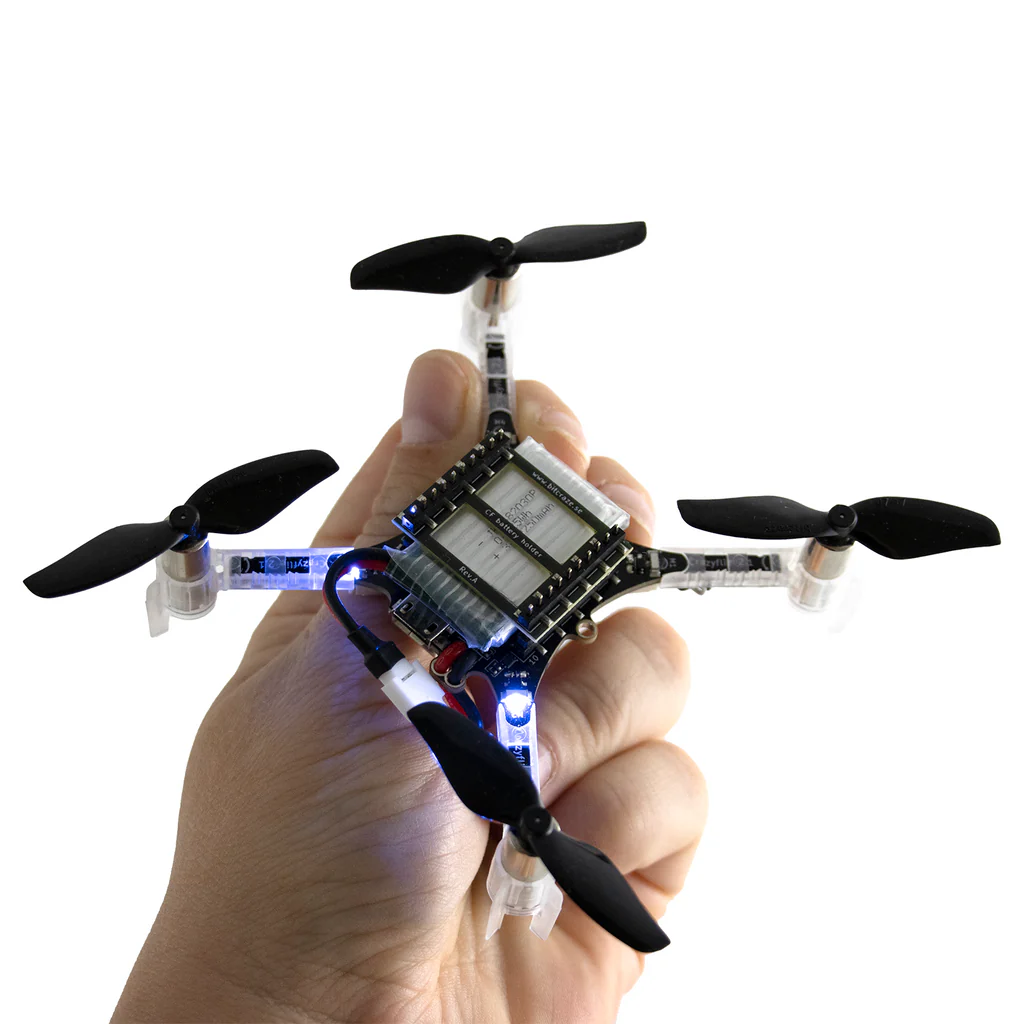
Bitcraze Crazyflie 2.1
- Commercial, off-the-shelf (270 EUR)
- Sensors:
- Inertial Measurement Unit (IMU)
- Actuators:
- 4 brushed motors with propellers
- Compute:
- Flight control: STM32 microcontroller (ARM Cortex-M4, 168 MHz, 192 kb RAM, 1 MB flash)
- Communication: nRF51 (ARM Cortex-M0, 32 MHz, 16 kB RAM)
- Size: ca. 9cm rotor-to-rotor
- Weight: ca. 27g
Flight Space
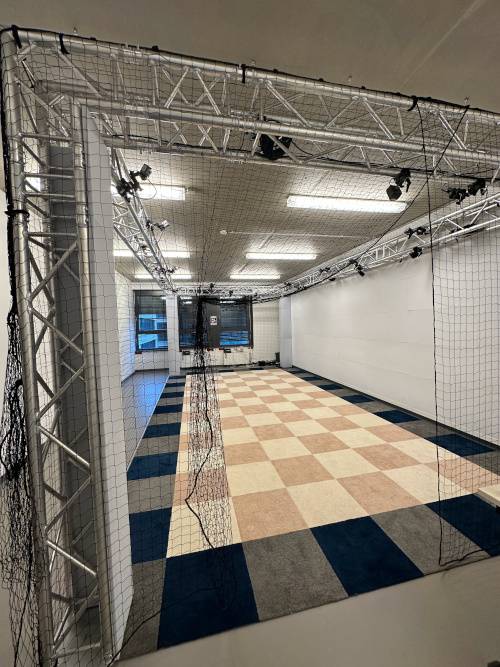
MAR 4.014
- 7 x 4 x 2.75 m
- with safety nets and padding
- external tracking systems for ground truth
- Optitrack motion capture
- LightHouse
Time Commitment
9 ECTS (270h):
Lecture: \(5 \cdot 1.5 = 8h\)
Discussion \(15 \cdot 1.5 = 23h\)
230h programming, testing (i.e. 15h/week)
Lectures/Discussions on Friday (10am-2pm; with breaks; MAR 0.013)
Time slots for practical part throughout the week (MAR 4.014)
Grading
- Portfolio: 4 assignments (20 points each) + oral exam (15min; 20 points)
- Assignment deliverables: code (for simulation and real flights), flight demo (for 3 out of the 4), verbal discussion (10min)
- Grading scale:
| 1.0 | 1.3 | 1.7 | 2.0 | 2.3 | 2.7 | 3.0 | 3.3 | 3.7 | 4.0 |
|---|---|---|---|---|---|---|---|---|---|
| 95 | 90 | 85 | 80 | 75 | 70 | 65 | 60 | 55 | 50 |
- This class does not count as “project” class, as required for some degrees!
Schedule (1)
| Week | Topic | Notes |
|---|---|---|
| 1 (Oct 17) | Intro, Rust, Dynamics (1D + 2D) | |
| 2 | Dynamics 3D | Assignment 1 out |
| 3 | Discussion | Enrollment due |
| 4 | Discussion | |
| 5 | Grading Assignment 1 | Grade Assignment 1 |
| 6 | Geometric Controller (1D, 2D, 3D) | Assignment 2 out |
| 7 | Discussion | |
| 8 | Presentation of simulation results |
Schedule (2)
| Week | Topic | Notes |
|---|---|---|
| 9 | Flight tests | |
| 10 | Flight tests | Grade Assignment 2 |
| (holiday) | ||
| (holiday) | ||
| 11 (Jan 9 ) | EKF | Assignment 3 out |
| 12 | Discussion | |
| 13 | Flight tests | Grade Assignment 3 |
| 14 | Motion Planning | Assignment 4 out |
| 15 | Discussion | |
| 16 | Flight tests | Grade Assignment 4 |
Related Classes (TUB)
- Robotics: Fundamentals, Robotics: both have practical parts (ground robots and manipulators)
- Robotics Project, Event-based Robot Vision: Project, Learning and Intelligent Systems: Project: project courses without curriculum
We focus on compute-constrained systems and use Rust.
It’s a regular class, not a project, with emphasis on the practical part.
Related Material
- Dynamics and Control of Autonomous Flight, book from 2025 by Mark W. Mueller
- Lecture notes of classes at UC Berkley; less practical
- Handbook of Robotics, Chapter 26 “Flying Robots”
- More concerned with the mechanics than the algorithms
- Robotics: Aerial Robotics on Coursera
- Only MATLAB simulations
- Underactuated Robotics by Russ Tedrake
- Very mathy cross-section of robotics; simulation only
Prerequisites
- Background in robotics (e.g., Robotics course by Oliver Brock)
- Strong programming skills in a low-level language (e.g., C) and a high-level language (e.g., Python)
Enrollment Procedure
Due to the flight tests, the class is limited to 10 students.
- If you remain interested, please enroll by Nov 1st
- If you drop the class, please also send me a message / E-Mail (waiting list)
Statement of Changes To Last Year
- Assignment 1 will include synthetic test data to rule out issues with dynamics implementation
- The controller will include the correct formulation of higher-order terms (was incorrect in slides and scientific papers)
- We will also use Rust for motion planning
- (If time allows) A few more advanced topics for the lecture part
Questions
?